Moravec's Paradox Is Your AI BS Filter
Moravec’s paradox states that high-level reasoning requires very little computation, while low-level sensorimotor skills require enormous computational resources. This is why artificial intelligence can draft a complex board memo and still fall apart on a task a teenager can do without thinking.
If you want to cut through the current marketing noise, Moravec’s paradox is one of the best filters around. It explains why machines can look brilliant in narrow, abstract work but remain oddly clumsy in messy, real-world situations. This distinction is vital when you are buying software, redesigning workflows, or evaluating claims that a chatbot is on the verge of AGI or ready to replace half of your team.
The most useful question is not “Is this AI smart?” Instead, you should be asking, “Smart at what?”
What Moravec’s paradox means in plain English
In plain English, Moravec’s paradox says this: computers often handle tasks humans find mentally hard, but struggle with tasks humans do almost on autopilot. Think algebra, not shoelaces. Think checkers and chess, not crossing a crowded kitchen without bumping into anything.
That sounds backwards until you stop equating what feels easy with what is simple. A child can recognize a face in bad light, pick up a cup, and adjust their grip without a rulebook. A machine still has to work incredibly hard for that. This concept was identified in the 1980s by researchers Hans Moravec, Marvin Minsky, and Rodney Brooks, who noticed that while symbolic reasoning is easy to program, the physical world remains a challenge.
Why checkers and chess are easier for machines than walking and seeing
Checkers and chess are full of rules, symbols, and clean states. So is math, and so are many business tasks that live inside forms, fields, and formal logic. A machine can search options fast and follow clear instructions all day. However, these systems often fail at basic perception and mobility.
Walking through a room is nothing like a game of chess. The floor might be wet, the dog might be asleep in the wrong place, or the mug you want might be half-hidden behind a bowl. Those are tiny judgment calls, but there are thousands of them. A good plain-English overview of Moravec’s paradox confirms that what feels automatic to us is actually the hard part for machines because it requires vast amounts of sensorimotor knowledge.
The evolution piece that makes the paradox make sense
The reason for this gap lies in human evolution. Balance, depth perception, hand control, facial recognition, and social reading were tuned over millions of years by natural selection. Your brain has a massive amount of dedicated machinery for those jobs, and most of it runs in the background.
Abstract math is much newer, writing is new, and formal logic is new. We had less time to turn those skills into instinct, so they still feel effortful to us. For computers, that setup flips. Rules are easier to encode than bodies, senses, and the everyday common sense that our ancestors spent eons perfecting.
How Moravec’s paradox helps you see through AI hype
Most AI marketing bets on one simple confusion: people see a polished output and assume a reliable capability. Moravec’s paradox tells you not to make that leap.
It pushes you to ask where the task lives. Is it clean, narrow, and mostly symbolic? Or messy, physical, and full of exceptions? That split explains a lot of the gap between flashy demos and useful products. By attempting to reverse engineering human intuition, modern machine learning often hits a wall when faced with the chaotic reality of unstructured work.
The tasks AI can fake fast, and the ones it still can’t do well
AI is often good at drafting emails, summarizing meetings, sorting documents, extracting fields from stable forms, and matching patterns across large text sets. Reimbursement coding, ticket routing, slide cleanup, and first-pass contract review are attractive use cases for the same reason. The inputs are legible, and the outputs are easier to check.
It still struggles when timing, touch, context, or physical reality matter. This is particularly visible in the latest generation of computer-use agents and GUI agents. These tools look impressive in curated videos, but they frequently fail when navigating software interfaces that contain unexpected pop-ups, lag, or non-standard layouts. Packing a suitcase without crushing anything or understanding that “ship it today” means something different when inventory is stuck in customs are not exotic problems. They are normal work.
Why a smart demo can still hide a weak product
A demo can be true and still be misleading. Give an AI clean data, a friendly prompt, a fixed process, and a human ready to rescue it, and it may look amazing. Benchmarks can do the same trick. So can a single lucky output.
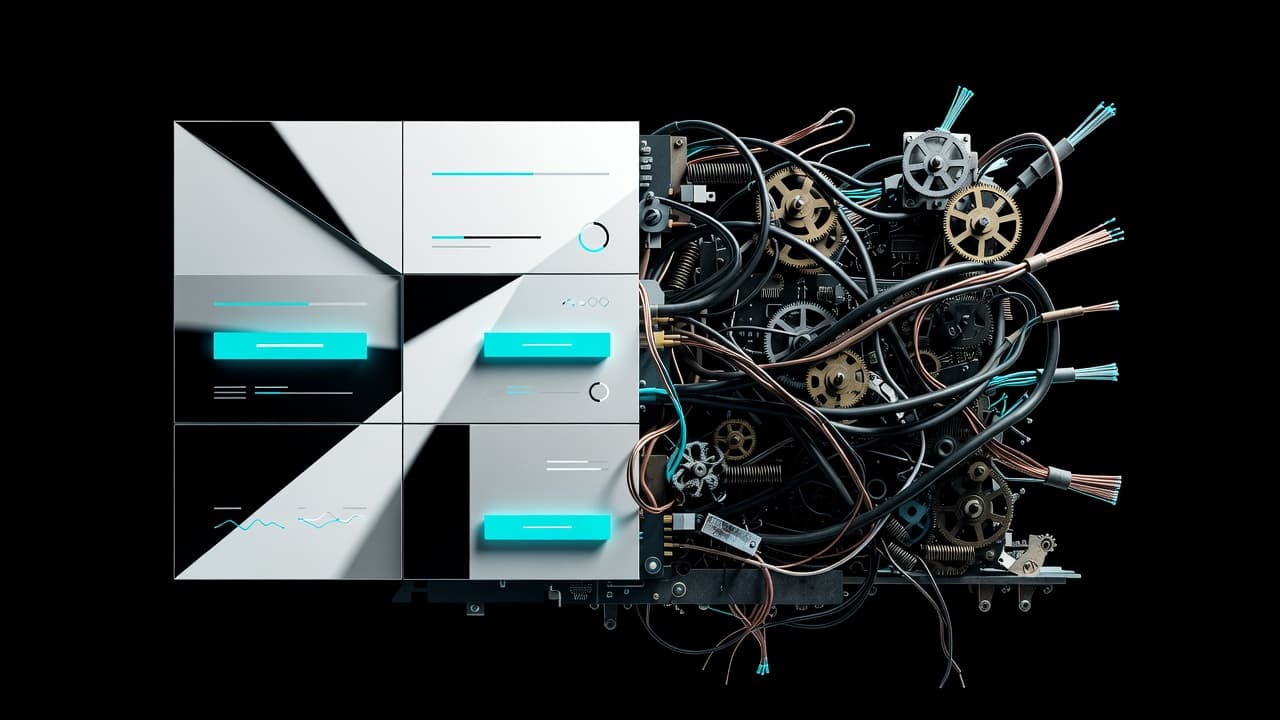 Real work is meaner. People upload the wrong file. They use broken templates. They ask half-formed questions. Systems time out. Policies conflict. Edge cases arrive before lunch. That gap between stage performance and daily productivity sits inside Forbes’ look at Moravec and the AI productivity paradox. If the product only shines inside a controlled script, you are not looking at intelligence. You are looking at staging.
The questions that expose AI BS quickly
You can expose most AI BS in a few minutes. Ask the questions vendors prefer to skip.
If nobody can tell you how the system fails, you’re looking at theater.
- What exact task is it solving, not the broad department, the task?
- Are the inputs clean and repeatable, or messy and inconsistent?
- How often does it fail, and how is that measured?
- What happens on exceptions, conflicting data, and weird edge cases?
- Who fixes mistakes, and how much time does that take?
- Does it work inside the real process, with real systems, or only in a sandbox?
- After review and cleanup, is the total work lower?
The last question is the one that matters. If humans still do the hard part and clean up the mess, the automation story is weaker than it sounds.
Where the paradox shows up in real life and work
This idea is not academic. It shows up in inboxes, ticket queues, call notes, warehouse scans, CRM fields, travel booking, and customer support. Once you notice it, you start seeing the same pattern everywhere.
AI is often strong at text, summaries, and pattern matching
Text is the sweet spot because language can be turned into tokens, patterns, and probabilities. AI excels here because models are trained on internet-scale data using reinforcement learning and reward modeling to predict the most likely next step. That makes AI useful for first drafts, summaries, translation, tagging, search, code suggestions, and recurring classification work. In office settings, that is enough to create real value.
Useful does not mean trustworthy. Models can invent facts, flatten important detail, or sound more certain than they should. They can give you a clean summary that misses the only line that mattered. That mismatch is captured well in this short take on Moravec’s paradox. AI can do the shiny, smart-looking task and still miss the grounded human one sitting next to it.
The messy parts, context, judgment, and physical reality
Now look at the hard stuff. A support agent has to hear frustration, spot risk, remember policy, protect the relationship, and decide when to bend. A nurse reads body language, timing, and the room. A plant operator knows when a noise is normal and when it means trouble.
None of that looks like complex cognitive processes performed by a computer. Instead, it depends on tacit knowledge, memory, sensory input, and judgment under uncertainty. Highway lane-keeping is hard, yet a busy loading dock may be harder because the requirements for visual perception are less formal and the exceptions never stop. Humans handle that with an intuitive, deep understanding of the world. Machines still need narrow setups, strong guardrails, or a person in the loop.
Why enterprise tools fail when the process is not clean
This is where many enterprise AI projects hit the wall. Leaders hope AI will fix a messy process, broken master data, weak ownership, and five competing exceptions. It will not. It usually scales the confusion.
If approvals are unclear, documents are inconsistent, and no one agrees on the right answer, the model has nothing solid to lock onto. The result is not a transformation. It is faster production of inconsistent outputs. AI likes structure, but most organizations have less of it than they think.
A simple framework for judging any AI claim
You don’t need a PhD to judge an AI claim. You need a simple screen and the discipline to use it.
Ask whether the task is narrow or open-ended
Narrow tasks are better bets. Think invoice field extraction from one template, call summary in a fixed format, or defect detection on a stable production line. The boundaries are clearer, and the error cases are easier to define.
Open-ended tasks are where hype grows fast. “Run customer success.” “Replace analysts.” “Manage procurement exceptions.” The more the job depends on taste, trade-offs, politics, or shifting context, the less you should trust the magic show. This is particularly relevant when you consider that while abstract thought is easily digitized in the modern digital economy, physical automation remains a major hurdle.
Check how much human oversight is still needed
A lot of good AI works because a person is still checking, correcting, routing, or reframing the output. That is fine. Plenty of tools are worth using even with review. A helper can still save time.
 But be honest about the economics. If the human still does the hard part, the AI is not an autonomous worker. It is a helper with limits. Measure whether review time, rework, and error cost go down. If they do not, the value is not there. You should exercise strict human oversight, especially for tasks that require complex sensorimotor skills, which is the traditional domain of robotics.
Watch for the gap between usefulness and magic
This is the last filter, and maybe the most useful one. A tool can be helpful without being revolutionary. Saving 20 minutes on notes is real. Better search across contracts is real. Faster first drafts are real.
You do not need sci-fi claims to get value. Most business gains come from small improvements that repeat every day. The loudest promise is often the weakest one. The best AI tools feel a bit boring, and they are far from the sentient humanoid robots often portrayed in media. These practical tools simply remove friction; they do not pretend to be people.
Clear thinking beats AI hype
Moravec’s paradox is a vital reminder that machine intelligence is inherently uneven. Artificial intelligence can be stunningly capable in one lane while remaining completely clueless in the next.
This is exactly why both blind excitement and blanket fear miss the mark. While machines excel at complex logical reasoning, they often fail at the simple, fluid common sense that humans navigate effortlessly. The most effective approach is to objectively evaluate the specific task, the potential failure mode, and the real cost of cleanup.
When you apply this framework, much of the surrounding AI hype stops looking impressive. By using the principles behind Moravec’s paradox to separate genuine utility from technical spectacle, you can focus on the small sliver of automation that is actually useful